MOATS (original) by Adrian Billington & Tanel:
MOATS 2.0 (RAC-aware) by Sidney Chen:
SQL Dashboard by Jagjeet Singh:
Both are RAC-aware, use terminal coloring techniques like my (fish.sql 🙂 and some Exadata metrics.
A couple of screenshots from their tools:
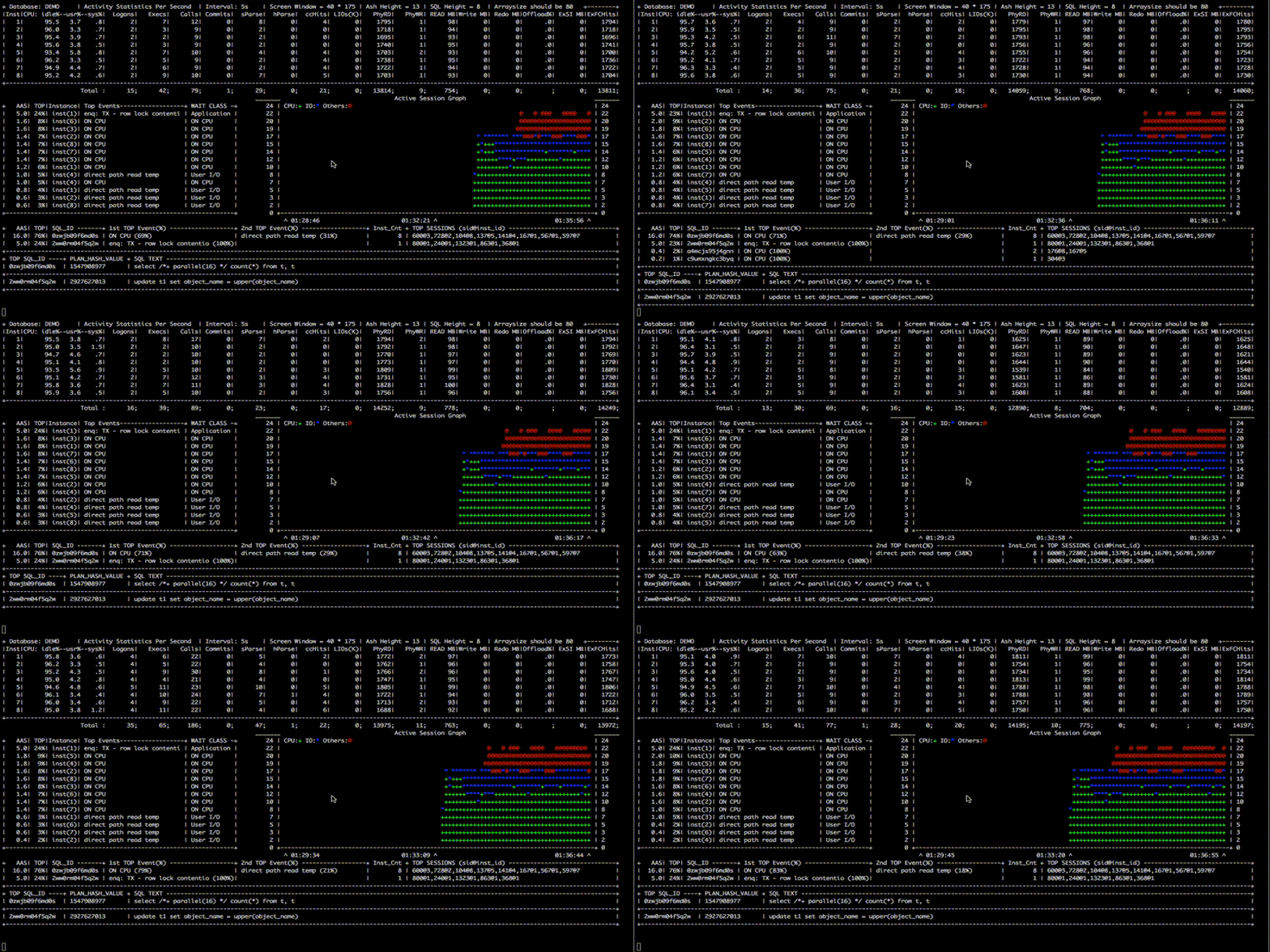 

)

)
I’ve taken down the original video of MOATS (I actually messed something up in Youtube and the video disappeared 🙂 If you’d like to see the original MOATS, you can download it from Adrian’s website site (current version 1.05) and make sure you read the README.txt file in the zip!
Also thanks to Randolf Geist for finding and fixing some bugs in our alpha code (and anyone else that have contributed!)
P.S. Have you already figured out how the top-style screen refreshing in SQLplus works?! 😉
_NB! If you want to move to the "New World" – offload your data and workloads to Hadoop, without having to re-write your existing applications – check out Gluent. We are making history! ;-)_
Related Posts
- List Exadata Disk Layout and Topology with the exadisktopo scripts
- List Exadata Storage Cell disk summary with cellpd.sql and cellpdx.sql scripts
Share this post:
- Click to share on Twitter (Opens in new window)
- Click to share on Facebook (Opens in new window)
- Click to share on LinkedIn (Opens in new window)
- Click to share on Google+ (Opens in new window)
- More
– ← An index of my TPT scriptsOracle Troubleshooting TV Show: Season 1, Episode 01 😉 →« Previous12 1. says:[
November 19, 2014 at 9:50 am](http://blog.tanelpoder.com/2011/03/29/moats-the-mother-of-all-tuning-scripts/comment-page-2/#comment-186524)Hi Tanel,I have been using MOATS for very long time but today was the first time i noticed something i never did….in the SQL_ID section i saw (o) , () …..would you happen to know why that would be the case, would that be related to commits or something that might causing that ?
- TOP SQL_ID (child#) —–+ TOP SESSIONS ———+
8% | 8043r26wd1bkv (0) | 1205,1281,845
8% | (0) |
5% | 3s31uz4j0amyx (0) | 1752,1521
5% | 3v581my0fv517 (0) | 621,606
4% | () |
+————————————————–+ Reply
– Tanel Podersays:[
November 24, 2014 at 4:59 pm](http://blog.tanelpoder.com/2011/03/29/moats-the-mother-of-all-tuning-scripts/comment-page-2/#comment-187934)It’s probably how Oracle keeps track of (and doesn’t always properly restore) SQL_IDs in v$session when for example running a recursive query (or SQL in trigger) which then finishes and returns to the parent query. If you want to drill down into this – I’d use either sql*trace (with 10051 trace possibly for OPI calls) or ASH (top_level_call_name/sql_opname)« Previous12Your email address will not be published. Required fields are marked *
Comment
Name *
Email *
Website
Notify me of follow-up comments by email.
Notify me of new posts by email.